Independent certification and accreditation
Certification of management systems.
International Standards Accreditation Organization (ISAO) certifies management systems against international standards and records every certificate it issues on a public register that anyone can check. Through ISAO-BAR it also accredits certification bodies and training organisations.
Services
What we do
Certification is open to any organisation; accreditation is for certification bodies and training organisations. Verification, the standards pages and the complaints procedure are open to everyone.
Certification
We audit an organisation’s management system against the standard it chooses, issue a certificate of registration when it meets the requirements, and keep it under surveillance.
Accreditation
We assess the competence and impartiality of certification bodies and training organisations, and accredit each one for a defined scope.
Certificate verification
Check a certificate by its number, verification code, QR code or the organisation’s name, and see its issuer, scope and current status.
Complaints and appeals
Anyone can complain about our work, an accredited body or a certificate on the register, and certification bodies can appeal our decisions.
About ISAO
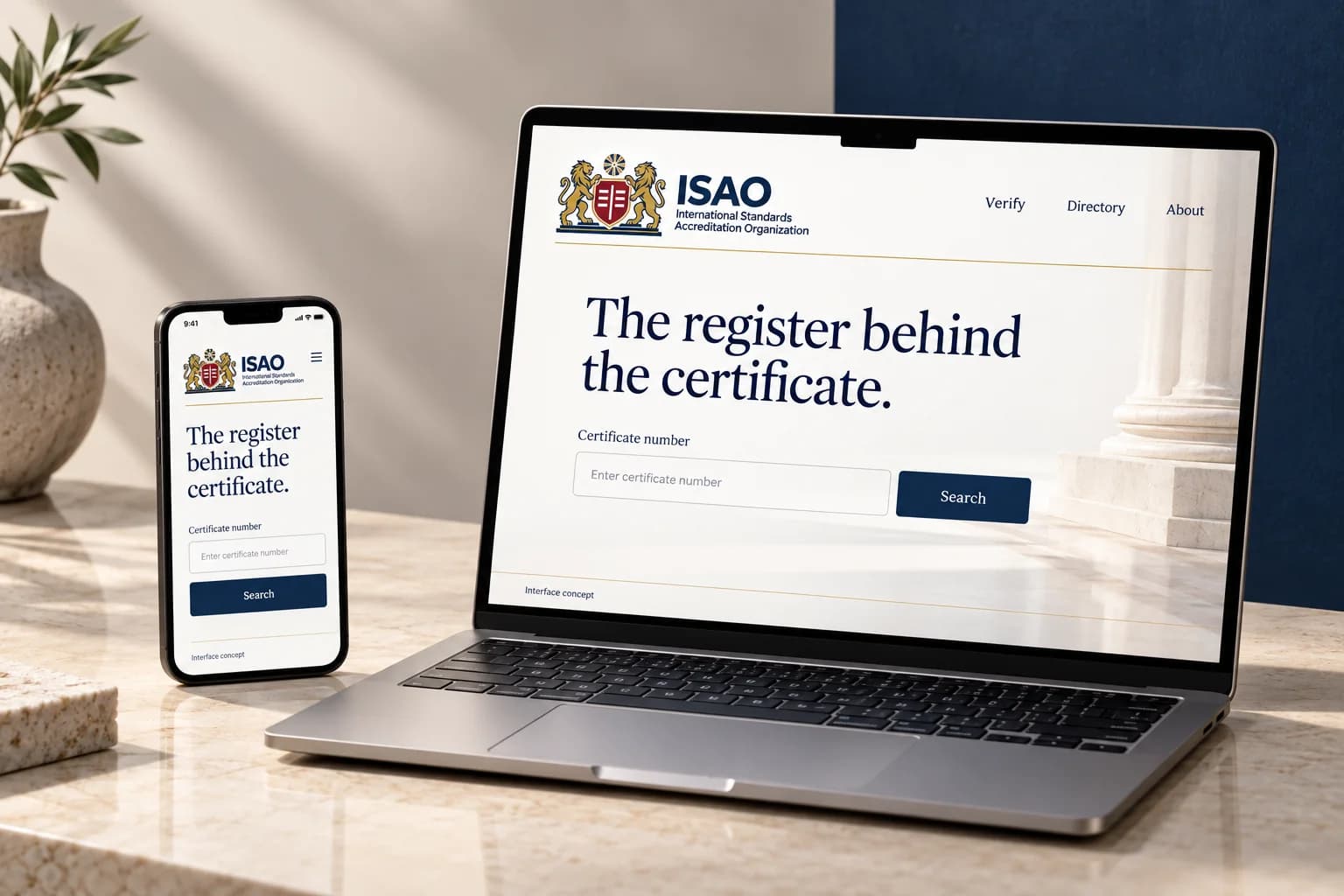
The register behind the certificate.
International Standards Accreditation Organization (ISAO) is an independent organisation, established in 2024. It certifies management systems against international standards and issues certificates of registration. Through ISAO-BAR it also accredits certification bodies and training organisations, and it also administers an auditor registration scheme. ISAO works independently and impartially, under published rules.
Assessment is kept apart from decision-making. Grants, suspensions and withdrawals are recorded on the public register, so a certificate can be checked against its current status.
The crest. Two lions frame a shield of ordered lines, a record held in trust, beneath a radial emblem: a shared point of reference.
Verification
Check a certificate before you trust it.
Search the public register to review a certificate’s issuer, scope and current recorded status.
How verification works
Search the register
Enter the certificate number, the verification code printed below its QR code or the certified organisation’s name, or scan the QR code.
Read the record
The record shows the certificate’s status today, its standard and scope, and who issued it.
Compare it with your copy
If the record differs from the copy you were given, do not rely on the certificate until the holder or ISAO has explained why.
What the certificate status means
- Valid
- In force today, issued by a body accredited to issue it.
- Suspended
- Not valid while suspended. Do not rely on it unless it is reinstated.
- Withdrawn
- Cancelled. It is no longer valid and must not be relied on.
- Expired
- Its period of validity has ended.
The issuer’s status is separate
For a certificate issued by a certification body, the record also shows that body’s own accreditation status, for example:
AccreditedAccreditation suspendedAccreditation withdrawn
Check both statuses before you rely on a certificate.
What the certificate status means
- Valid
- In force today, issued by a body accredited to issue it.
- Suspended
- Not valid while suspended. Do not rely on it unless it is reinstated.
- Withdrawn
- Cancelled. It is no longer valid and must not be relied on.
- Expired
- Its period of validity has ended.
The issuer’s status is separate
For a certificate issued by a certification body, the record also shows that body’s own accreditation status, for example:
AccreditedAccreditation suspendedAccreditation withdrawn
Check both statuses before you rely on a certificate.
For certification bodies
How accreditation works
Every certification body goes through the same six stages. Accreditation covers a defined scope and stays under surveillance while it lasts.
Step 1: Application
The certification body applies, setting out the standards, sectors and countries it wants to cover.
Step 2: Document review
We review its management system, procedures and records against our accreditation rules.
Step 3: Office assessment
Assessors visit its office to see how audits, auditors and certification decisions are managed.
Step 4: Witness audit
An assessor observes the body’s team carrying out a real certification audit.
Step 5: Decision
The accreditation committee reviews the findings and decides whether to grant accreditation, and for which scope.
Step 6: Surveillance
Accredited bodies are assessed at regular intervals. Any change of status is published on the register.
Next steps
Apply for accreditation
Check who can apply and the fees, then apply by email with the standards, sectors and countries you want to cover.